

Why do conspiracy theories favour Argentina?
Eight factors explain why Argentina became the conspiracy theorist's preferred beneficiary.

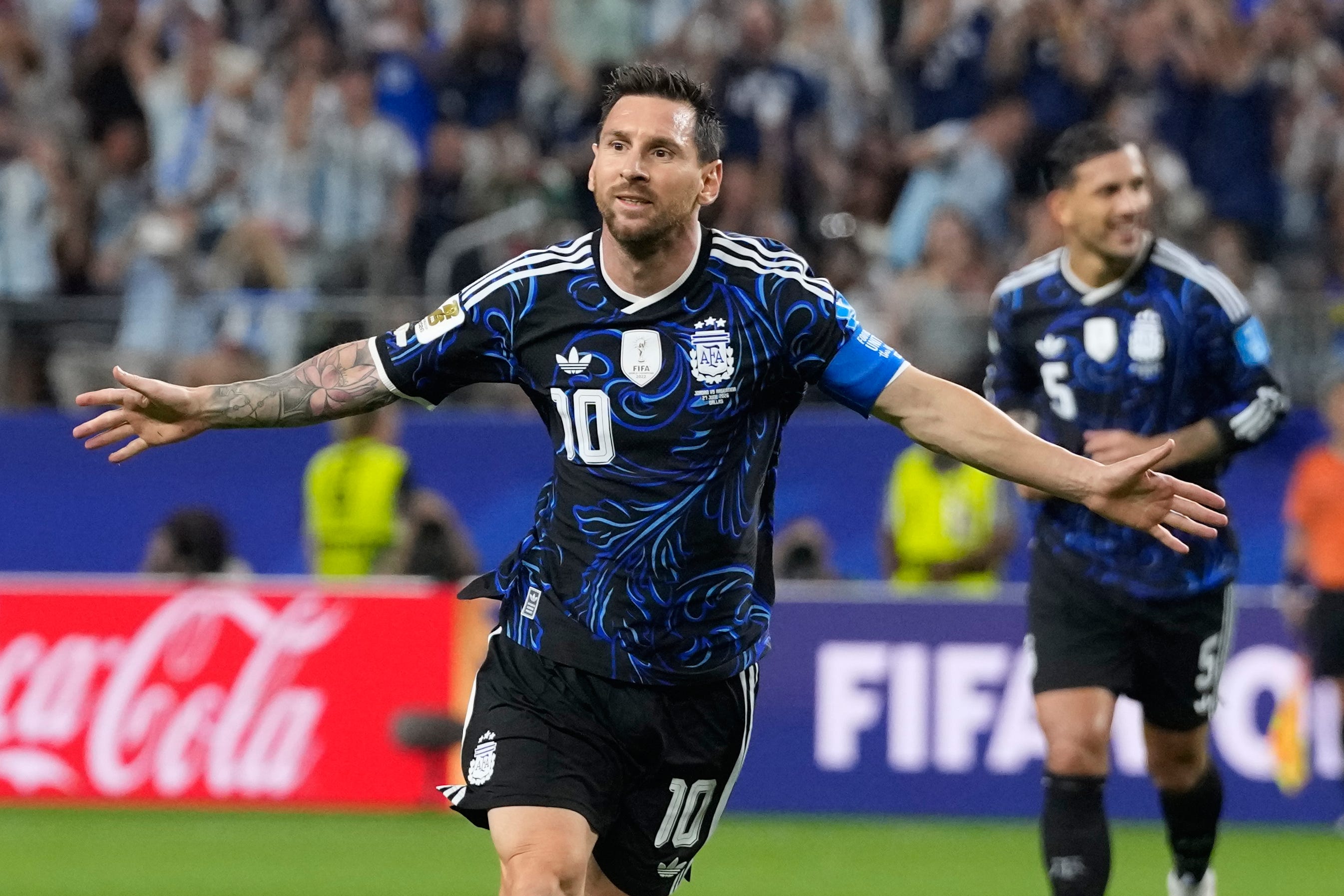
A prevailing conspiracy theory holds that FIFA and other powerful commercial interests are influencing the World Cup to ensure that Argentina win it.
The more revealing question isn’t whether the accusation is true, but why believers identify Argentina as the preferred winner rather than another major football nation such as Spain or England.
The central reason is that the alleged beneficiary isn’t really Argentina. It’s Lionel Messi.
Argentina supplies the team, but Messi supplies the motive, the narrative and the imagined commercial payoff. Spain and England are valuable football markets, but neither offers FIFA the same singular, emotionally legible story: the universally recognised genius completing, or further extending, his legacy on the world’s largest stage.
That distinction explains why the theory has attached itself so persistently to Argentina, and it can be broken down into eight related factors.
1. Messi makes Argentina uniquely “scriptable”
Conspiracy theories become persuasive when events resemble a story that someone might plausibly have written.
Argentina’s recent World Cup campaigns contain an unusually complete narrative:
* the ageing genius pursuing the one prize that once eluded him;
* redemption after several lost international finals;
* comparison with Maradona;
* a final opportunity before retirement;
* the captain carrying a historically important football nation;
* enormous global audiences invested in the outcome.
The 2022 final drew a reported global audience of approximately 1.42 billion, while commercial analysis found Messi generated exceptional social-media advertising value during the tournament.
That doesn’t establish manipulation. It does explain why people can readily imagine FIFA preferring that outcome.
Spain winning would be a story about an excellent national system. England winning would be a story about a powerful football country ending a long drought.
Messi winning is a story about the apparent completion of one of sport’s greatest individual biographies. Conspiracy theories attach themselves more readily to the third.
2. Argentina offers a plausible commercial motive without requiring an implausible sporting result
A convincing sports conspiracy needs a beneficiary capable of winning legitimately.
Trying to make a weak country champion would require extensive and obvious interference. Argentina already possesses elite players, institutional football strength and a realistic path to victory. The imagined conspirators would therefore need only to influence marginal events:
* a generous penalty;
* a disciplinary decision;
* a favourable VAR interpretation;
* an advantageous draw;
* additional tolerance toward a star player.
That distinction matters psychologically. The theory doesn’t require believers to imagine that FIFA choreographs every pass. It requires only the belief that officials can place a thumb on the scale at a few decisive moments.
Research on football refereeing gives that weaker claim some plausibility. In an experimental study, Nevill, Balmer and Williams asked qualified referees to assess recorded incidents either with or without audible crowd noise. Referees exposed to the crowd made fewer decisions against the home team.
The authors concluded: “The noise of the crowd influenced referees’ decisions to favour the home team.” They suggested that the effect may arise from “the need to avoid potential crowd displeasure by making a decision in favour of the home team.”
A separate study of penalty decisions in Norway’s top division found evidence of bias associated with team status. Erikstad and Johansen reported that “successful teams were more likely to receive an incorrect penalty compared with their opponents” and were less likely to be denied penalties that should’ve been awarded.
They concluded that referees’ decisions “may be unintentionally biased by a team’s success.”
These findings support the limited proposition that crowd pressure and team status can influence individual refereeing decisions without conscious coordination. They don’t provide evidence that FIFA centrally organises or fixes match outcomes.
3. Controversial decisions provide visible “evidence”
In 2022, Argentina received five penalties during the tournament. Several were disputed, which allowed separate incidents to be assembled retrospectively into a single pattern. Online discussion explicitly connected the penalty count with the proposition that a Messi victory would be more profitable for FIFA.
The important mechanism is cumulative interpretation. Once someone suspects preferential treatment, every ambiguous decision becomes additional confirmation:
* Argentina receives a debatable decision.
* The observer interprets it through the existing theory.
* The decision strengthens the theory.
* Later neutral or adverse decisions receive less attention.
Football is particularly susceptible because many important decisions are genuinely contestable. Slow-motion replay often increases confidence without eliminating ambiguity.
4. FIFA has destroyed the presumption of innocence
People don’t begin with a neutral prior about FIFA.
The organisation’s documented history of corruption, political accommodation and opaque decision-making means that allegations of manipulation don’t sound inherently absurd.
Recent commentary on the 2026 tournament has again linked suspicion around Argentina to broader distrust of Gianni Infantino and FIFA’s willingness to intervene politically or administratively.
That distinction matters:
* “FIFA has acted corruptly before” is historically grounded.
* “Therefore FIFA has fixed Argentina’s matches” doesn’t follow.
But the first proposition makes audiences much more receptive to the second.
5. Messi sits at the intersection of several institutions that conspiracy theories already distrust
The narrative has changed slightly between tournaments.
In 2022, Messi played for Paris Saint-Germain, owned by Qatar Sports Investments, while Qatar hosted the World Cup. This produced an intuitively powerful—although evidentially weak—chain:
Qatar hosts the tournament → Qatar owns Messi’s club → Messi winning benefits Qatar’s prestige and investment.
In 2026, Messi’s position in American football performs a similar function. His move to Inter Miami significantly increased attendance, merchandise interest and the commercial profile of Major League Soccer. With the tournament held largely in the United States, believers can construct another chain:
FIFA wants the American tournament to succeed → Messi is central to American football’s growth → a deep Argentina run maximises attention.
Reports during the current tournament have explicitly connected suspicion of favourable treatment with Messi’s commercial importance in the United States.
Again, commercial alignment isn’t proof of coordination. It merely supplies a motive-shaped explanation.
6. Why not Spain?
Spain has immense football prestige, but its appeal is structurally different.
Spain’s value lies primarily in:
* technical quality;
* club institutions such as Real Madrid and Barcelona;
* a repeatable development system;
* a collection of elite players.
Its national team lacks one individual whose victory can be marketed as a world-historical personal culmination. Its identity is distributed across players and institutions. A Spanish victory demonstrates footballing superiority; an Argentine victory can be narrated as destiny.
Conspiracy theories prefer identifiable agents, motives and beneficiaries. “FIFA wants Messi’s coronation” is simpler than “FIFA wants Spain’s decentralised football-development model to succeed.”
7. Why not England?
England is commercially enormous, but it’s a poor candidate for the same emotional narrative.
First, England’s attraction is concentrated heavily around the Premier League. Much of the world consumes English club football while actively wanting the English national team to lose. Commercial importance doesn’t necessarily create global emotional identification.
Second, England is culturally coded as part of football’s establishment: wealthy league, powerful media, colonial history and disproportionate international attention. An England victory would therefore be interpreted less as a gift to a beloved individual and more as crude favouritism toward an already dominant market.
Third, England lacks the Messi mechanism. Ending the “years of hurt” is compelling domestically, but it isn’t a universally shared personal story. There’s no single English player whose final triumph would function as the apparent completion of an era.
Finally, suspicion often follows rivalry. England attracts hostility because of its media and historical position, but that hostility usually produces the claim that England is overrated, not that FIFA has constructed an entire tournament around one transcendent English figure.
8. Argentina combines populism and elite commercial value
Argentina occupies an unusual symbolic position.
It is simultaneously:
* a traditional football power;
* a country repeatedly afflicted by economic and political crisis;
* culturally associated with emotional, improvised and street-level football;
* represented by one of the world’s most commercially valuable athletes.
That allows contradictory audiences to invest in the same story. Ordinary supporters see passion, adversity and national redemption. Sponsors and broadcasters see Messi, global recognition and enormous engagement. Conspiracy theorists interpret this convergence as evidence of elite orchestration.
Spain looks institutional. England looks wealthy and establishmentarian. Argentina can look both romantic from below and commercially useful from above.
Overall Assessment
People suspect that FIFA would rig a World Cup for Argentina rather than Spain or England because Argentina offers the ideal conspiracy-theory beneficiary:
a legitimately excellent team, a globally adored protagonist, an extraordinary commercial audience, a narratively perfect outcome, ambiguous refereeing incidents and an organising institution that has already forfeited public trust.
The theory therefore isn’t primarily a judgement about Argentina’s geopolitical importance. It’s an attempt to explain why reality has repeatedly resembled the most marketable possible Messi screenplay.
Its persuasive power comes from the fact that the alleged motive is plausible even though the alleged mechanism remains unproven.