


For most of its short history, cryptocurrency has been presented as an alternative to the financial system.
Bitcoin emerged from the global financial crisis with a radical premise: digital money could be transferred directly between people without a bank standing between them.
Washington increasingly has a different idea.
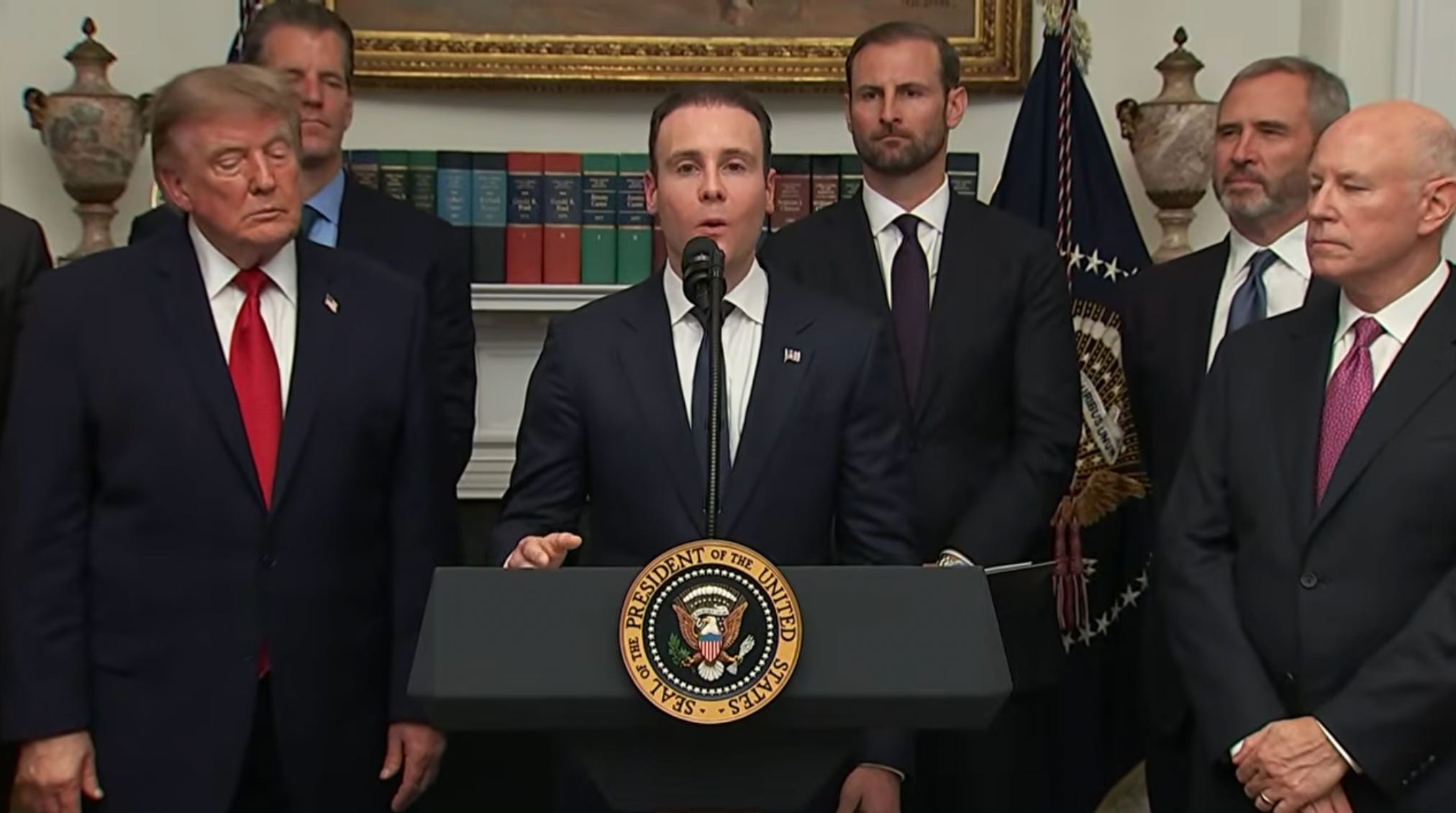
At a White House meeting this week, President Donald Trump sat alongside the heads of the Securities and Exchange Commission and Commodity Futures Trading Commission, and executives from Coinbase, Robinhood, Kraken, Ripple, Chainlink, Nasdaq and Intercontinental Exchange, the owner of the New York Stock Exchange.
The meeting preceded the inaugural gathering of the CFTC’s new Innovation Advisory Committee, whose inaugural meeting focused on crypto assets, artificial intelligence and prediction markets.
The language was characteristically bullish. Trump declared that the United States would remain the world’s dominant financial and technological power. Industry executives praised his administration. Regulators promised clearer rules and less interference.
But underneath the ceremony was a more consequential economic idea.
The United States is beginning to treat blockchain not as a parallel financial system, but as infrastructure through which the existing one might expand.
That starts with the dollar.
Last year, Trump signed the GENIUS Act, America’s first federal regulatory regime specifically for payment stablecoins. Stablecoins are digital tokens designed to maintain a fixed value, usually one US dollar.
Under the law, regulated issuers must maintain identifiable reserves backing their outstanding tokens at least one-for-one using approved assets, including cash, bank deposits and US Treasury securities with maturities of 93 days or less.
The significance is easy to miss because stablecoins still carry the cultural baggage of crypto.
Economically, however, a dollar stablecoin is something much simpler. It is another way of holding and transferring dollars.
A worker in Argentina can receive one. A business in Nigeria can settle an invoice with one. A trader in Singapore can move one between exchanges. Transactions can occur at any hour and across borders without requiring users to hold physical American currency or, in some cases, a conventional US bank account.
The technology is new. The unit of account is not.
That distinction appears increasingly central to American policy.
During the White House meeting, one participant argued that stablecoins were already increasing the international distribution of the US dollar while simultaneously moving more Treasury securities into the reserves backing them. He described the effect as a tangible expansion in the use of US-issued assets.
The claim comes from an industry with a direct commercial interest in wider adoption, and should be treated accordingly. But the underlying mechanism is real.
If demand for regulated dollar stablecoins rises, their issuers need more reserve assets. Under the GENIUS Act, those reserves can include short-term Treasury securities. More digital dollars can therefore increase demand for the government debt used to back them.
That does not mean every dollar of stablecoin growth creates an equivalent dollar of new Treasury demand. Some of the money may simply migrate from bank deposits, money-market funds or other vehicles that already hold government debt. But it does create another channel through which demand for dollar assets can expand.
This turns one of cryptocurrency’s original assumptions on its head.
Rather than weakening the dollar, parts of the crypto economy may strengthen its distribution.
The comparison with the Eurodollar system is imperfect but useful. During the second half of the twentieth century, dollars held and lent outside the United States helped turn the American currency into the working money of global commerce.
Stablecoins could perform part of that function in a digital economy: dollar liabilities circulating internationally on infrastructure that never closes.
The White House discussion went further.
Several participants spoke about moving conventional financial assets onto blockchain networks. Robinhood chief executive Vlad Tenev said his company was already using tokenisation to make American assets available in more than 120 countries and argued that the technology could eventually extend beyond listed shares to private companies.
Tokenisation sounds more exotic than it is.
Modern securities are already overwhelmingly electronic. Tokenisation changes the infrastructure on which ownership and transfers are recorded.
A tokenised security is a digital representation of a financial asset or claim recorded on a distributed ledger. A share, bond or other financial claim that currently moves through the databases of brokers, custodians and clearing institutions can instead be represented and transferred through blockchain-based infrastructure.
The underlying asset does not necessarily change. A tokenised Treasury is still a claim connected to US government debt. A tokenised share is still supposed to represent an economic interest in a company.
What changes is the machinery around it.
Settlement could become faster. Markets could remain open for longer. Assets could become easier to divide into smaller units. Some administrative functions could be automated. Financial products that currently live in separate technological systems could eventually become interoperable.
None of this is guaranteed.
Tokenisation does not abolish securities law, custody risk, fraud, taxation or the need to establish who actually owns what. Nor does putting an asset on a blockchain automatically make a market more liquid or efficient. In some cases, the existing system may already work well enough that replacing it offers little economic advantage.
American regulators nevertheless appear to be preparing for a world in which more conventional assets move on-chain.
SEC chairman Paul Atkins said in July that the agency was working on rules governing how market participants can custody and trade tokenised securities. The SEC’s 2026 agenda explicitly treats traditional securities placed on blockchains as part of its regulatory programme while attempting to separate them from crypto assets that it does not regard as securities.
This week the SEC also proposed a tailored regime for some capital raisings involving crypto assets. The stated objective is to make it easier to raise capital while retaining disclosure and investor-protection requirements.
Meanwhile, Trump is pushing Congress to pass the CLARITY Act, which would establish a broader statutory structure for digital-asset markets and more clearly divide regulatory authority between the SEC and CFTC. The legislation remains politically contested, with the Senate scheduled to hold a crucial procedural vote on September 15 over whether to advance it.
That uncertainty matters.
Much of what was discussed at the White House remains direction rather than destiny. Regulations can change with administrations. Legislation can fail. Technological adoption can take much longer than its advocates expect.
There are also interests at stake that extend beyond technological efficiency. Banks have reasons to worry about deposits migrating into stablecoins. Crypto companies have reasons to encourage regulation that legitimises their products.
Exchanges have reasons to support markets that trade for longer hours and attract more participants. Politicians have reasons to present technological change as evidence of national resurgence.
Trump and his family also have substantial financial interests connected to cryptocurrency, creating an ethics issue that has become part of the congressional dispute over the CLARITY Act.
But none of this makes the underlying economic shift irrelevant.
The more interesting question is why the United States wants these technologies at all.
The answer offered repeatedly at the White House was national power.
Trump described financial technology as another arena of competition with China. CFTC officials said America could either write the rules governing the next generation of financial markets or allow other countries to write them instead.
The administration’s regulators have repeatedly spoken of bringing crypto businesses and financial innovation back onto American soil.
Seen in those terms, stablecoins and tokenisation fit comfortably into a much older American strategy.
The United States possesses the world’s dominant reserve currency and its deepest capital markets. Treasury securities form one of the foundations of the global financial system. American equities attract savings from almost everywhere.
Blockchain potentially provides a new global distribution network for those assets.
A dollar that can move instantly across a blockchain is still a dollar. A Treasury represented digitally is still American government debt. A tokenised share in an American company remains a claim on American enterprise.
The technology can change how an asset moves without changing the economic power behind it.
This is why the White House meeting matters more than another presidential endorsement of Bitcoin.
The first era of cryptocurrency asked whether software could create money outside the existing financial system.
The next may ask something almost opposite.
What happens when the world’s most powerful financial system turns its money into software?