


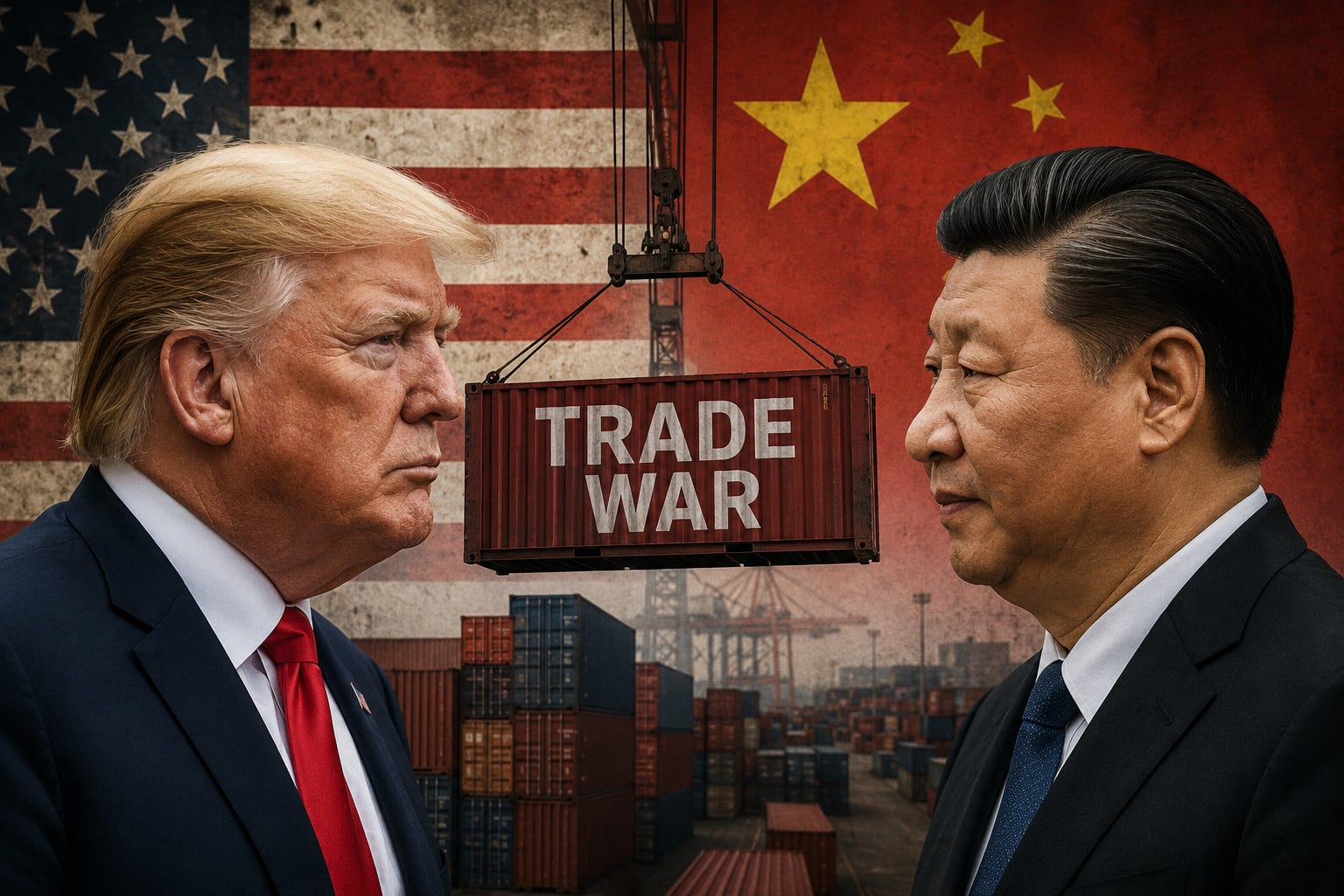
Trump’s trade war is best understood not as an attempt to reduce imports, but as an attempt to use access to the American consumer market to redirect global capital and productive capacity into the United States.
For most of the past year, Donald Trump’s trade war has been reported as a story about tariffs.
How much will they raise prices? Who ultimately pays them? Will China retaliate? Will American manufacturers benefit? Will they reduce the trade deficit?
These are reasonable questions. But they may be measuring the wrong thing.
Trump’s emerging trade system increasingly looks less like conventional protectionism than an attempt to change where the world builds things.
The instrument is the tariff. The leverage is access to the American consumer. But the objective increasingly appears to be productive capacity.
The clearest evidence is in the deals themselves.
Under the agreement reached with Japan last year, most Japanese imports face a baseline tariff of 15 per cent. Alongside that came something potentially more important: a $US550 billion Japanese investment commitment in the United States.
The framework identifies energy, semiconductors, critical minerals, pharmaceuticals, shipbuilding and artificial intelligence among the sectors into which that capital can be deployed.
The European Union struck a similar bargain: a 15 per cent tariff framework alongside expectations that European companies would invest an additional $US600 billion in the United States through 2028, while the EU intends to procure $US750 billion of American energy over the same period.
Tariffs create the pressure. Negotiations then produce concessions involving market access, purchases, investment and production.
This changes what Trump’s trade war actually is.
