The West Is Being Distracted by Immigration as Digital ID Becomes the Architecture of Control
A loud argument over borders has obscured a quiet redesign of how Western citizens will be identified, monitored, and governed.
By Nick Holt
Western politics is now organised around one issue: immigration. It dominates elections in Europe, shapes every political argument in Britain, drives the most volatile cultural debates in the United States, and has recently become Australia’s primary source of public anger.
What’s striking is that very different societies now react to immigration with the same fears, the same language, and the same images circulating through social media, as if they share a single emotional system.
At the same time, each of these jurisdictions is advancing major reforms to its digital identity systems. Governments are expanding biometric verification, building national identity wallets, strengthening data-linking powers, and redesigning how citizens authenticate themselves across public and private institutions.
These reforms represent some of the most consequential administrative changes of the century, yet they proceed with barely a fraction of the attention that immigration receives.
This contrast is not the product of a conspiracy; it follows from how modern information systems allocate attention. Immigration is emotionally charged, visually dramatic, and endlessly transmissible.
Digital identity is technical, procedural, and resistant to spectacle. One issue monopolises public focus; the other moves quietly in the background.
The result is a political landscape in which citizens argue about the issue that is loudest rather than the issue that will shape their relationship with the state for the next generation.
Immigration politics has particular properties that explain its dominance. It sits close to questions of identity, belonging, and nationalism, which gives it a level of emotional immediacy that most policy areas never attain.
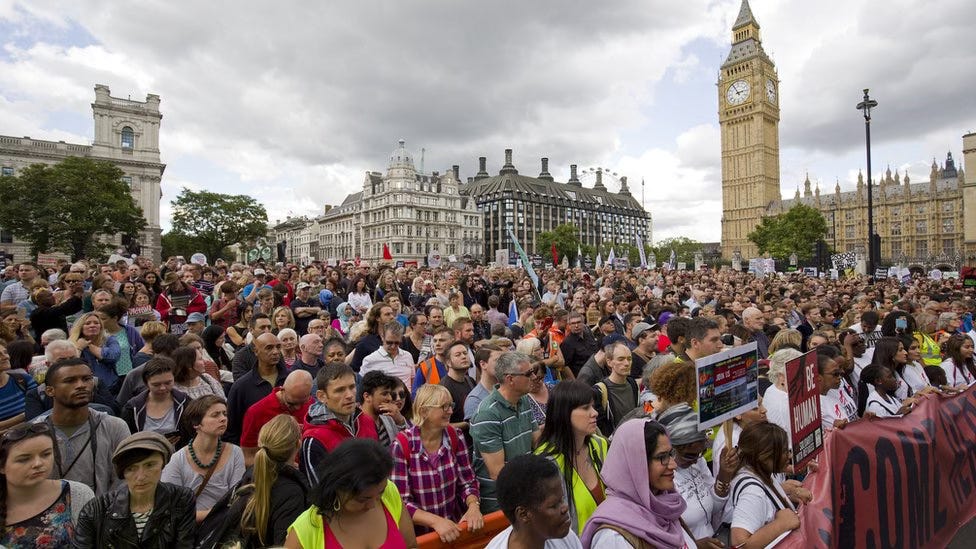
It generates abundant imagery—crowds at borders, street clashes, public protests, police responses. These images circulate rapidly, especially on X, where the algorithm now rewards conflict and outrage with enhanced exposure.
Once immigration becomes a salient concern, it produces a self-sustaining cycle of attention: people react to the images; the reactions generate engagement; the engagement ensures the platform pushes more of the same material.
Since Elon Musk acquired Twitter, the effect has intensified. Reduced moderation, algorithmic amplification, and a globalised content feed have collapsed the distance between national debates.
Footage from Dublin trends in Sydney before local journalists have even registered the story. A riot in Marseille becomes the frame through which an Australian interprets a policy debate in Melbourne.
European anxieties become American anxieties, which in turn become British and Australian anxieties. Immigration debates no longer reflect local conditions so much as a continuous stream of imported emotion.
This matters because public attention is finite. When a politically charged issue occupies the entire bandwidth of public debate, there is little capacity left to interrogate complex administrative reforms.
Digital identity legislation lacks the characteristics that attract sustained scrutiny. It cannot be conveyed through a thirty-second clip. It does not provoke visceral reactions. It cannot be reduced to a slogan. And it rarely produces the kind of political theatre that drives television coverage.
For most people, it is an abstract domain of bureaucratic design—the kind of issue that advances most easily when the public is preoccupied with something else.
Over the past five years, Western governments have taken advantage of this attention imbalance, whether intentionally or simply as a matter of sequencing.
The European Union has pushed ahead with its Digital Identity Wallet and biometric standards while its member states remain consumed by migration pressures on their borders.
Britain passed the Online Safety Act and expanded surveillance powers during the most polarised immigration debate since Brexit.
The United States continued to build out Real ID and state-level digital credential systems while its political class argued incessantly about the southern border.
Australia advanced its Digital ID 2.0 legislation during the exact period in which immigration became a sudden cultural flashpoint, fuelled more by international footage circulated on X than by domestic conditions.
In each case, immigration supplied the emotional noise; digital identity moved forward in the quiet. The two developments need not be coordinated for the dynamic to hold. It is simply easier to pass technically complex reforms when the public is focused elsewhere.
Governments have long understood that timing often determines whether a reform is contested or unobstructed. When parliament is absorbed by a high-temperature debate, legislation that lacks headline potential can move through committee stages and into law with minimal resistance.
The implications are significant. Citizens are engaged in a prolonged argument about migration numbers, integration, and culture, while paying comparatively little attention to the systems that will soon govern how they identify themselves to banks, employers, telecommunications providers, and government agencies.
Immigration may shape a nation’s social character, but digital identity systems determine the administrative architecture of citizenship. They shape what information the state holds, how it is linked, who can access it, and the conditions under which individuals interact with essential services.
These reforms are not peripheral; they alter the balance of power between citizens, corporations, and the state.
It is possible to acknowledge that migration places pressure on housing, wages, and infrastructure without accepting the proposition that immigrants are responsible for every domestic failure.
Much of the current panic reflects deeper frustrations: underbuilt housing markets, stagnant real wages, ageing populations, and governments that depended on high migration while neglecting the systems required to support it.
Immigration is the visible surface of a structural problem, not its cause. But because it is visible, it becomes the easiest target for public anger, while the less visible issue evolves without oversight.
The central claim is straightforward: Western societies debate symptoms while ignoring systems. Immigration dominates because it is emotionally legible. Digital identity is overlooked because it is institutionally complex. When these two dynamics collide, the result is a democratic blind spot in which the issue consuming the most attention is not the issue redistributing the most power.
A more sober reading is that Western democracies are not avoiding a balanced debate by accident. The imbalance is structural. Emotional issues dominate because they are profitable, politically useful, and algorithmically amplified. Technical reforms advance quietly because they are easier to legislate when the public is preoccupied. The idea that governments will voluntarily restore balance misunderstands the incentives at work.
Immigration will not become rational simply because rational debate is desirable. Digital identity will not become transparent simply because transparency is demanded.
These outcomes require political pressure, institutional accountability, and a public capable of distinguishing what feels urgent from what is actually transformative. At present, the system produces the opposite: a loud argument about borders and a silent redesign of the administrative state.
The uncomfortable truth is that democracies change not only through public consent but through public distraction. And distraction has become the most dependable political resource of all.


