


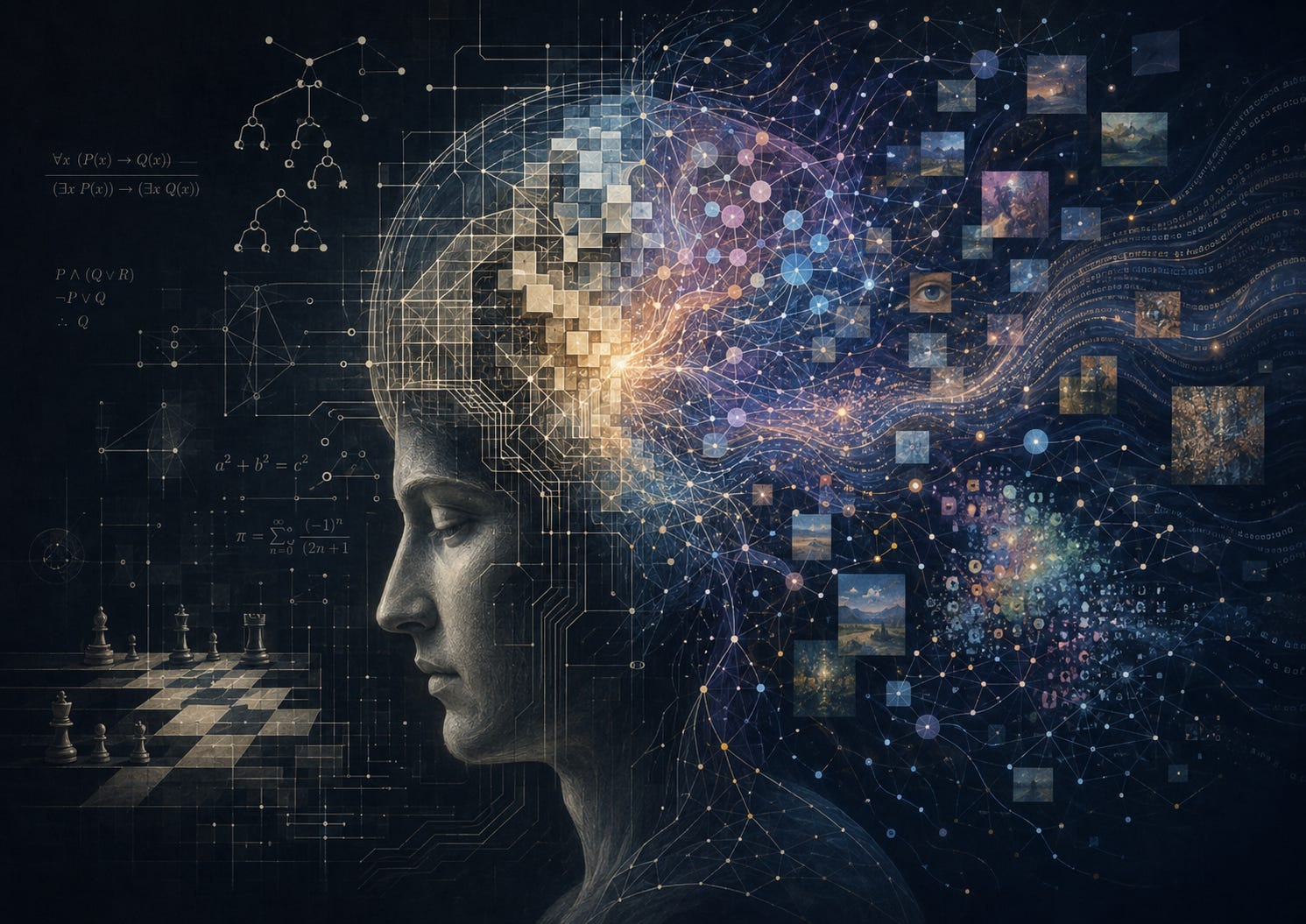
Artificial intelligence began with a surprisingly simple proposition.
Reasoning might be mechanical.
Not easy. Not necessarily human. But reducible, at least in principle, to operations that could be described precisely enough for a machine to perform them.
That proposition predates the computer. Aristotle formalised patterns of valid inference. Leibniz imagined a system in which disputes could one day be resolved by calculation. George Boole turned propositions into algebra.
But the idea acquired physical consequence in the twentieth century.
In 1936, Alan Turing described an abstract machine capable, in its universal form, of simulating any computation that can be expressed as an effective procedure. The machine itself was imaginary. The implication was not.
If some part of intelligence consisted of computation, there was no obvious reason computation had to occur inside a human skull.
By the time electronic computers arrived in the 1940s, the question had changed.
It was no longer whether machines could calculate.
It was what else calculation might contain.
In 1950, Turing asked the question explicitly: Can machines think?
Six years later, a group of mathematicians and computer scientists gathered at Dartmouth College around an even more ambitious proposition.
John McCarthy, Marvin Minsky, Nathaniel Rochester and Claude Shannon proposed that every aspect of learning or intelligence might, in principle, be described precisely enough for a machine to simulate it.
McCarthy gave the project its name.
Artificial intelligence.
The field has spent the seventy years since arguing about what intelligence actually consists of.
And, broadly speaking, two answers have repeatedly dominated.
The first was that intelligence is something like reasoning.
The second was that intelligence is something like learning.
Neither has proved sufficient on its own.
The machine that reasons
The tradition that came to dominate early artificial intelligence was built around symbols.
A computer would represent things in the world explicitly, apply rules to those representations and search through possible conclusions.
This was intelligence as formal reasoning.
One of the earliest programs, the Logic Theorist, created by Allen Newell, Herbert Simon and Cliff Shaw in the 1950s, proved mathematical theorems. Other systems solved algebra problems, played games and manipulated logical propositions.
The attraction was obvious.
Human reasoning appeared to involve concepts and relationships. Computers were good at manipulating symbols according to exact rules. Perhaps intelligence could be reconstructed from sufficiently sophisticated versions of the same process.
Give the machine facts.
Give it rules.
Let it reason.
For a while, the results were remarkable.
Computers solved problems previously assumed to require intelligence. Programs conversed in restricted English. Robots navigated simplified environments. Machines proved theorems and planned sequences of actions.
But they worked best when the world had first been reduced to something the computer could understand.
That turned out to be the problem.
Consider the difference between chess and a kitchen.
Chess has 64 squares, 32 pieces, explicit rules and a finite set of legal moves. Every relevant state of the game can be represented precisely.
A kitchen contains cups, steam, broken handles, slippery floors, half-ripe bananas, missing teaspoons, people who change their minds and thousands of facts nobody bothers stating because everybody already knows them.
Human beings operate inside that ambiguity effortlessly.
Computers did not.
The field had discovered something important about intelligence, but it repeatedly ran into the gap between a world that could be formally represented and the one human beings actually inhabit.
Reality contained too much knowledge to write down.
Knowledge becomes the problem
By the 1970s, AI researchers increasingly recognised that intelligent reasoning required enormous amounts of background knowledge.
Their response was not to abandon symbolic reasoning but to give it more knowledge.
The result was the expert system.
Instead of building a machine capable of thinking about everything, researchers attempted to capture the expertise of a specialist in one narrow field.
A medical system might contain rules linking symptoms, laboratory findings and diseases. A geological system might reason about mineral deposits. A corporate system might reproduce the decision rules of an experienced employee.
The central assumption had changed slightly.
Intelligence was not merely reasoning.
It was reasoning applied to knowledge.
The systems worked surprisingly well in restricted domains.
But they revealed another problem.
Much of what people know cannot easily be expressed as a rule.
A radiologist can often recognise something unusual in an image before being able to explain exactly what produced the judgement. A mechanic hears an engine differently after thirty years of repairing them. A child can distinguish a dog from a wolf without possessing a formal definition of either.
Human intelligence contains vast quantities of tacit knowledge.
We know more than we can specify.
That made expert systems expensive to build and difficult to maintain. Every exception required another rule. Every new situation exposed another assumption that had never been written down.
The machine could reason precisely from its representation of the world.
Its problem was that the world refused to fit inside the representation.
Artificial intelligence entered one of several periods of disappointment that became known as AI winters.
But another tradition had existed beside symbolic AI almost from the beginning.
Perhaps humans did not need to tell machines what all the rules were.
Perhaps machines could learn them.
The machine that learns
In the 1950s, Frank Rosenblatt built the perceptron, an early artificial neural network that adjusted numerical connections in response to examples.
Instead of programming:
IF these features appear, THEN this object is a cat,
the machine would be shown examples of cats and non-cats and alter itself until it became better at distinguishing them.
The difference sounds technical.
It was philosophical.
Symbolic AI attempted to transfer human knowledge into a machine.
Machine learning attempted to make the machine acquire useful representations itself.
Early neural networks were too limited, computers were too slow and datasets were too small for the idea to fulfil its promise.
That changed gradually.
Researchers developed better learning algorithms. Digital systems generated enormous quantities of data. Computing power increased. Graphics processors designed for rendering images turned out to be unusually good at the mathematics used by neural networks.
Then, in 2012, a neural network called AlexNet entered the ImageNet image-recognition competition and dramatically surpassed the previous state of the art.
The result changed the direction of the field.
The old approach to computer vision relied heavily on humans deciding which features of an image mattered.
Edges.
Shapes.
Textures.
Corners.
The neural network learned useful features for itself.
The programmer increasingly stopped specifying the features that constituted the solution.
The system learned them from data instead.
Deep learning spread through image recognition, speech recognition, translation and eventually almost every major area of artificial intelligence.
In 2016, DeepMind’s AlphaGo combined deep neural networks with search to defeat one of the world’s strongest Go players. The achievement was especially significant because Go had resisted conventional brute-force approaches: its possible positions were simply too numerous.
AlphaGo learned which positions mattered and used search selectively rather than blindly.
The machine had not been given a human grandmaster’s complete theory of Go.
It had learned.
The centre of gravity of AI had moved.
Then came language
For decades, language remained one of the hardest problems in artificial intelligence.
Human sentences are sequential, but their meaning depends on relationships that can stretch across paragraphs. A word near the end of a sentence can depend on something introduced near the beginning.
In 2017, eight Google researchers published a paper with an unusually confident title:
Attention Is All You Need.
It introduced the Transformer.
The crucial mechanism was called self-attention. Instead of processing language principally as a simple chain, the model could calculate relationships between different pieces of the input and determine which mattered to one another.
The architecture was also highly parallelisable, making it unusually well suited to large-scale computation.
Transformers produced another change whose importance was not immediately obvious.
One increasingly powerful use of the Transformer was to train very large language models on enormous quantities of text using an apparently primitive objective.
Predict what comes next.
Given enough text, however, predicting what comes next is not primitive at all.
To predict language well, the system benefits from representations that capture grammar.
Meaning.
Relationships between concepts.
Facts encoded in text.
Patterns of argument.
And, at sufficient capability, structures that can support forms of reasoning.
The machine was not being given an encyclopedia of explicit rules.
It was being forced to compress regularities within human language into billions of numerical parameters.
This was not the symbolic intelligence imagined at Dartmouth.
It was something almost inverted.
Scale changes the object
GPT-3 made the implications difficult to ignore.
Released in 2020, the model contained 175 billion parameters. More important than its size was its behaviour.
The same model could translate text, answer questions, imitate styles, complete patterns and perform tasks presented to it through examples without being separately trained for each one.
The distinction between program and user interface began to blur.
Instead of selecting a specialised program and operating its controls, people could increasingly describe what they wanted in ordinary language.
Then, on November 30, 2022, ChatGPT made that capability accessible to the public.
Its importance was not that a computer could suddenly produce sentences.
Computers had been producing sentences for decades.
The important change was that language itself had become an interface to computation.
A person could ask for an explanation, a program, an argument, a summary, a classification or a plan without knowing which internal operations were required to produce it.
The computer had moved one layer closer to intention.
And yet the extraordinary flexibility of these systems exposed a weakness that should have looked familiar.
They could be wrong.
Not merely because they lacked information.
They could generate statements that were grammatically perfect, conceptually plausible and factually false.
The problem was almost the mirror image of symbolic AI.
The old systems were rigid but inspectable.
The new systems were flexible but probabilistic.
An expert system could fail because the world had not been represented in its rules.
A large language model could operate fluently across domains without possessing any mechanism guaranteeing that its answer was true.
AI had escaped one prison by entering another.
The return of reasoning
This is why the most interesting development in artificial intelligence is not simply that models are getting larger.
It is that learned models are increasingly being surrounded by machinery that does what learned prediction alone cannot reliably do.
Search.
External memory.
Tools.
Exact computation.
Structured representations.
Verification.
Modern AI systems increasingly do not rely on a neural network to perform every operation itself.
They can search the web for information they do not possess.
They can execute computer code rather than approximate arithmetic in language.
They can retrieve documents rather than rely entirely on model memory.
They can interact with databases and software.
They can inspect the result of an action and decide what to do next.
By 2025, frontier reasoning models could select and combine tools during a task — searching, running code, examining files and altering their approach according to the results.
This is a subtle but important change.
The model no longer has to be the entire intelligence.
It can become the component that decides which kind of intelligence a problem requires.
A neural system can interpret an ambiguous human request.
A search engine can retrieve current evidence.
A calculator can perform exact arithmetic.
A database can preserve state.
A formal solver can determine whether a logical constraint is satisfiable.
Another neural model can explain the result in English.
The architecture begins to look less like a synthetic brain and more like a cognitive system.
And this brings artificial intelligence strangely close to where it began.
The two minds
The history of AI is usually presented as a sequence of breakthroughs.
Turing.
Dartmouth.
Expert systems.
Neural networks.
Deep learning.
Transformers.
ChatGPT.
Reasoning models.
But this chronology obscures the deeper argument taking place underneath it.
The deepest argument in AI has never really been whether machines can think.
It has been about how much of intelligence must be specified, and how much can be learned.
For seventy years, researchers have been testing different answers to that question.
One tradition builds explicit representations, rules and reasoning procedures.
The other learns useful representations from experience.
The first produced machines that could reason precisely inside worlds humans had carefully defined.
The second produced machines capable of operating across worlds humans could never completely define.
Neither solved intelligence.
Symbolic systems knew exactly how their conclusions followed from their premises, but struggled with the ambiguity of reality.
Neural systems absorbed that ambiguity, but could not reliably guarantee their conclusions.
The future may therefore belong neither to the machine that reasons nor the machine that learns.
It may belong to the machine that knows which one to use.
AI has spent seventy years negotiating the boundary between what intelligence must have explicitly specified and what intelligence can learn for itself.
Modern systems increasingly suggest that neither extreme is enough.
We spent decades building computers that could reason inside worlds we had formally described.
Then we built systems capable of learning the patterns of worlds we could never completely describe.
Artificial intelligence may now be entering the period in which those two histories finally meet.