

The Return of Regime Change — and the End of America First
How the Iran campaign signals a shift from restraint to structural intervention — and a foreign policy voters were never explicitly asked to approve

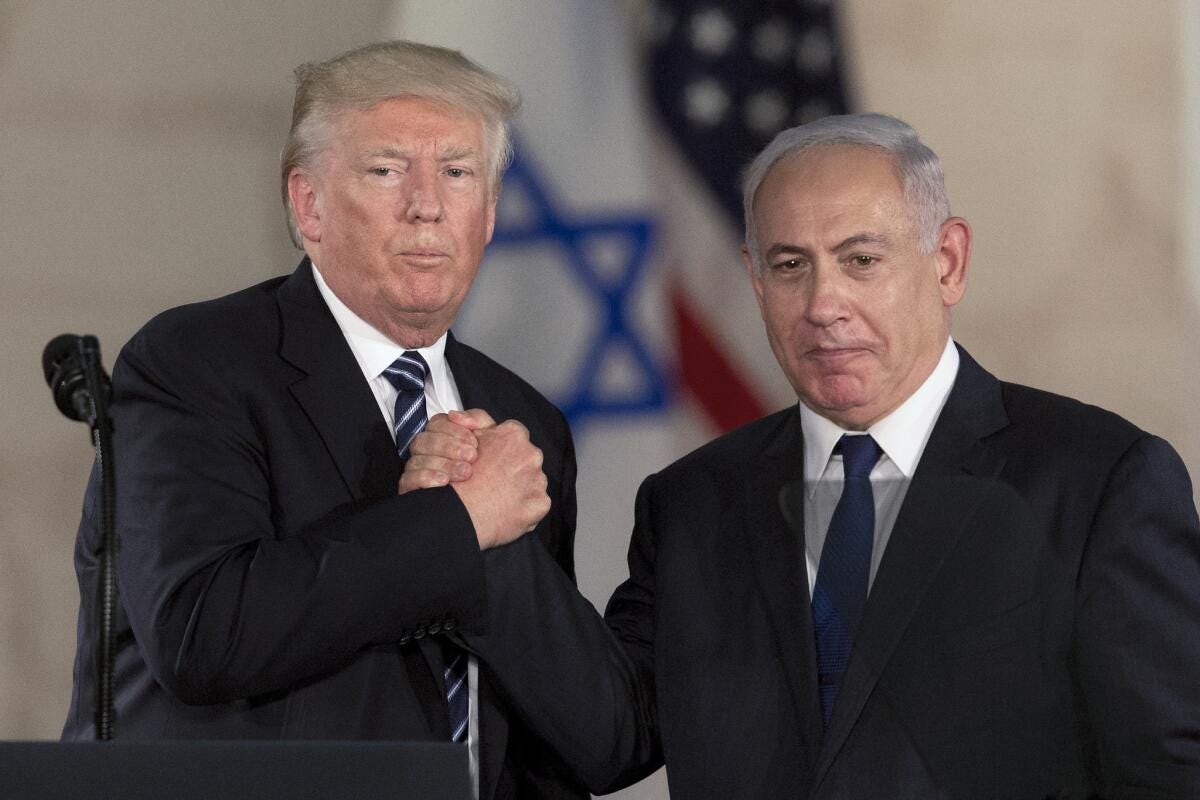
By Nick Holt
Monday, 2 March 2025
The current U.S.–Israeli campaign against Iran does more than escalate a regional conflict. It marks a decisive evolution in American foreign policy — one that voters were never directly asked to endorse.
Regime change, once rejected as the defining error of earlier administrations, has returned as an articulated objective of American power.
This version does not resemble Iraq in 2003. There are no divisions preparing for occupation. There is no language of reconstruction.
The method is structural: decapitation, sustained military degradation, and explicit encouragement of internal political transformation.
The objective is clear. It is the deliberate alteration of another sovereign state’s governing structure.
The tension lies not only in Tehran, but in the doctrine that brought President Donald Trump to office.
“America First” was not merely a slogan about trade or borders. It was a rejection of open-ended intervention in the Middle East.
It was a critique of regime-change wars that expended American lives and resources in pursuit of political transformation abroad.
It promised that American power would be used with restraint and directed toward clearly defined national interests.
The campaign against Iran places that doctrine under strain.
Regime change is not containment. It is not limited retaliation. It is not narrow deterrence. It is the most ambitious category of foreign policy available to a president. Even without occupation, it commits the United States to the political fate of another country.
The administration has acknowledged that additional American casualties are likely. That statement signals that this is not a symbolic strike. It is an open-ended undertaking whose costs are accepted in advance.
To understand how this evolution occurred, one must examine not only Washington’s calculations, but Jerusalem’s.
For more than three decades, Israel’s strategic doctrine has centered on preventing the emergence of a regional power capable of sustained state-level opposition. The First Gulf War crippled Iraq’s conventional strength.
The 2003 invasion removed Saddam Hussein entirely. Libya collapsed under NATO intervention and internal revolt. Syria fragmented under prolonged civil war and external pressure before its regime ultimately fell.
Hezbollah has been periodically constrained. Hamas has been repeatedly degraded.
Across this sequence, the regional balance shifted incrementally. State actors capable of mounting conventional pressure on Israel were removed or weakened. The effect was cumulative.
Iran remained.
Unlike Iraq or Syria, Iran preserved institutional coherence. It invested in long-range missile development. It built layered proxy networks across Iraq, Syria, Lebanon, and Yemen.
It positioned itself deliberately at the nuclear threshold without overt weaponization. It deepened ties with Russia and expanded economic alignment with China.
From Israel’s perspective, Iran became the central strategic threat. Not because of rhetoric alone, but because of structure. Iran possessed scale, missile capacity, demographic depth, and layered deterrence.
It could project influence without conventional invasion and apply pressure indirectly across multiple theatres.
For Prime Minister Benjamin Netanyahu, the neutralization of Iran has long been central. For more than two decades, he has publicly identified Iran as the primary threat to Israel’s long-term security.
He has warned against nuclear threshold ambiguity, missile proliferation, and proxy encirclement. He has argued for pre-emptive action when necessary.
What is unfolding now is consistent with that position. The difference is scale. The objective long articulated in Israeli strategy is now pursued with the weight of American military power.
American and Israeli interests do not fully overlap. The United States operates within a broader framework that includes alliance credibility, energy security, and competition with major powers. Yet in the case of Iran, the incentives align with unusual clarity.
The United States seeks to demonstrate enforcement credibility in a multipolar system. It seeks to show that red lines are enforceable. It seeks to deter adversaries from testing its posture.
Israel seeks the elimination of Iran’s missile and proxy infrastructure and the permanent removal of nuclear ambiguity.
Regime change advances both objectives.
What distinguishes the present moment is that this alignment has moved from tacit coordination to explicit convergence.
The removal of Iran’s supreme leader and the framing of the conflict as an opportunity for internal transformation reflect long-standing Israeli threat assessments while serving American deterrence goals.
The question is not whether the alignment exists. It is whether voters were asked to approve the shift.
In 2016, 2020, and again in 2024, regime-change wars were presented as cautionary failures. Iraq was cited as an example of overreach. The appeal of “America First” rested in part on rejecting that model. It promised restraint from precisely this form of intervention.
Iran is now treated as an exception.
Yet once regime change is embraced as an instrument of policy, restraint no longer defines the doctrine. The shift does not require formal declaration. It occurs through action. Strategic evolution replaces explicit electoral consent.
This transformation unfolds in a different international environment from 2003. Russia is active across multiple theatres. China depends heavily on Middle Eastern energy flows.
Global markets react immediately to instability in the Strait of Hormuz. Insurance rates, shipping routes, and commodity prices adjust within hours.
Regional actors possess asymmetric capabilities capable of inflicting disruption without conventional confrontation.
Regime change in this environment carries broader consequences.
If Iran fragments internally and a successor government abandons its regional posture, the strategic map will shift decisively. Israel would face no comparable state-level challenger. American deterrence credibility would appear reinforced.
If, however, decapitation consolidates hardline control, destabilizes energy corridors, or draws rival powers more directly into confrontation, the result may be prolonged volatility rather than transformation.
The decisive question is domestic.
The coalition that rejected regime-change wars must now decide whether Iran stands outside that principle — or whether the principle itself has shifted. The administration may argue that circumstances demanded adaptation. It may argue that Iran represents a unique case.
What it cannot argue is continuity.
The president who rose opposing regime change now presides over it. Whether this marks the permanent end of the restraint doctrine that defined his ascent will depend less on events in Tehran than on the response at home.
Regime change has returned.
“America First” has evolved into something else.