


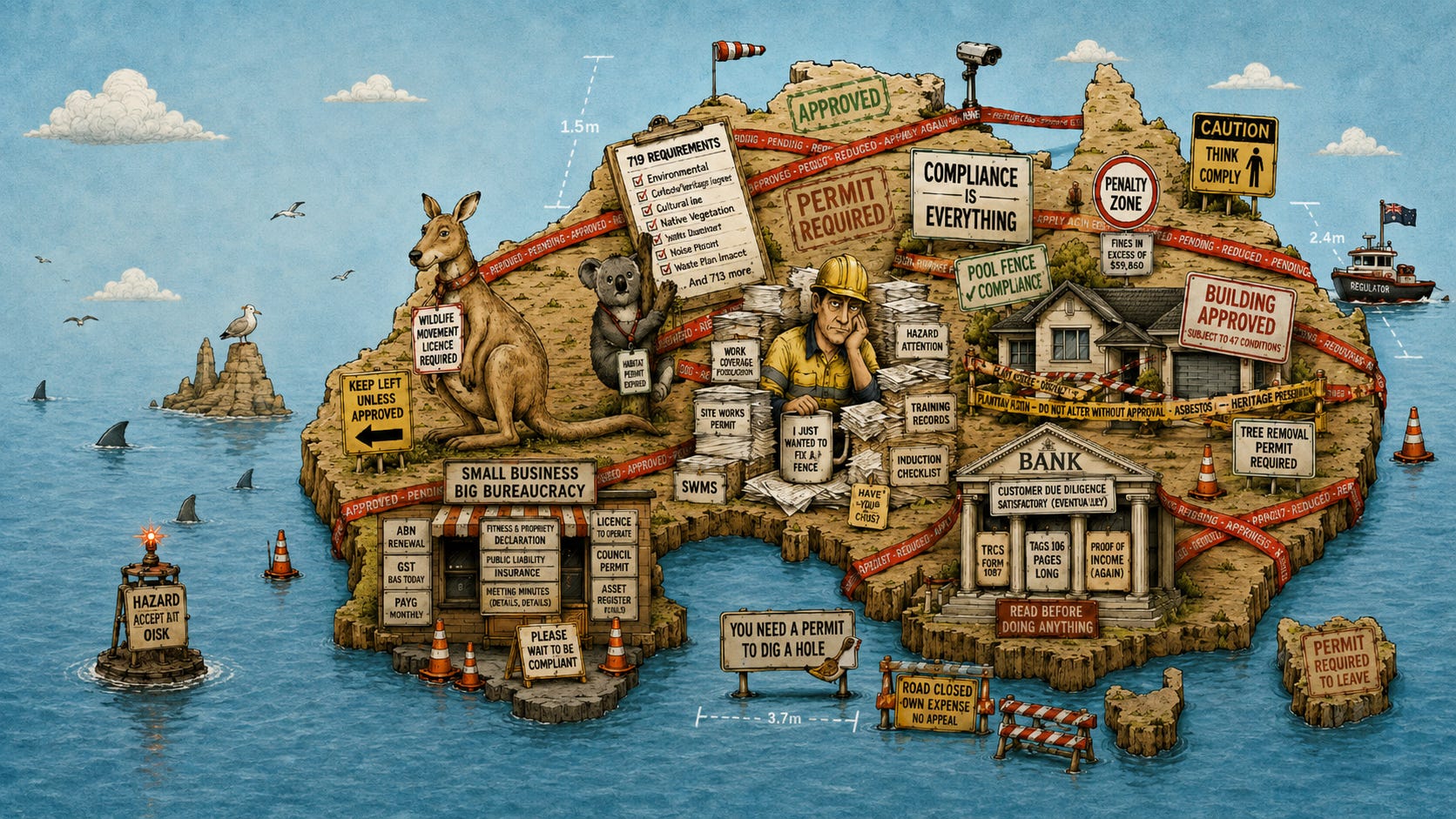
Perhaps the greatest threat to Australian productivity isn’t that we’ve stopped trying. But that we’ve stopped being allowed to.
Try opening a storefront, building a retaining wall, or giving someone financial advice. Try employing a mate, or cutting down a tree in your own backyard.
An invisible wall of paperwork stands between every problem and its solution. Every licence, permit or approval is just a new problem awaiting its own stamp of approval.
Someone has to say yes.
The obtrusion has become so commonplace in Australia that it is almost imperceptible.
We experience regulation as a series of individual annoyances rather than as a system — the council form, the compliance training, the insurance requirement, the mandatory disclosure nobody reads, the licence renewal.
Another afternoon spent proving you have permission to do what you already know how to do.
Each requirement usually has a reasonable explanation. That is partly why there are so many of them.
Australia did not become heavily regulated because a government decided that Australians should require permission to do everything.
It happened one defensible rule at a time. A building collapses. Someone loses their retirement savings. A worker dies. A company contaminates a river. A bank behaves badly. An inquiry follows. The inquiry finds a failure.
The failure becomes a recommendation. The recommendation becomes a law. The law becomes a regulation. The regulation becomes a form that somebody will be filling out twenty years later.
This is the machinery of the Australian regulatory state. Something bad happens, and the political system asks a remarkably consistent question: how do we make sure this can never happen again?
There’s nothing inherently unreasonable about that question.
The problem is that the answer is almost always another rule.
Australia has been doing this for a long time.
Long before anyone had heard the phrase “regulatory burden”, Australian governments were setting wages, arbitrating industrial disputes, protecting industries, owning utilities and determining the conditions under which businesses could operate.
The economic reforms of the 1980s and 1990s changed much of that.
Tariffs came down. Markets opened. Government businesses were privatised. Financial markets were liberalised.
But government did not simply leave the economy.
It changed its relationship with it.
Instead of owning the bank, it regulated the bank.
Instead of running the telecommunications company, it regulated the telecommunications company.
Instead of directly controlling prices and production, it increasingly controlled the conditions under which private actors were allowed to operate.
Australia became more market-oriented and more regulated at the same time.
That is not the contradiction it first appears to be.
The modern Australian economy is built around private ownership under public supervision.
There is another reason this arrangement persists.
Australia is a relatively small country with a highly developed economy, which means a surprising number of industries are dominated by a small number of firms.
Four big banks.
Two dominant supermarket groups.
A handful of insurers, airlines, telecommunications providers and energy companies.
In theory, competition disciplines bad behaviour.
If a business treats you badly, you leave. Someone else offers a better product. A new competitor enters the market.
But this works less well when there are only a few realistic alternatives.
Government then has three broad options.
Break the companies up.
Accept the concentration.
Or regulate what the companies are allowed to do.
Australia usually chooses the third.
The company remains private.
The market remains nominally competitive.
But an increasingly elaborate administrative structure grows around it.
That structure has its own logic.
Governments are punished far more severely for failing to prevent a disaster than they are for imposing another compliance requirement.
Imagine a financial collapse destroys thousands of retirement accounts.
The question will be immediate.
Where was the regulator?
Now imagine that preventing the next collapse requires 40,000 businesses to spend another five hours a year completing compliance paperwork.
There is no equivalent political moment.
Nobody holds a press conference for the lost afternoon.
The costs are dispersed so widely that they almost disappear.
The benefits, when regulation works, are equally difficult to see.
Nothing happened.
The building did not collapse.
The bank did not fail.
The worker did not die.
This produces a ratchet.
Rules are easy to add and difficult to remove.
Every regulation has a failure somewhere behind it. Every disclosure was created because somebody was misled. Every certification requirement exists because somebody once did something badly.
Removing the rule means accepting the possibility that the thing might happen again.
Politically, that is a much harder position to defend than adding another obligation.
So the layers accumulate.
And Australia is unusually good at accumulating them because the Australian state actually works.
The courts function. Taxes are collected. Regulators investigate. Businesses are registered. Professional licences mean something. Companies generally comply when the government tells them to do something.
Administrative competence is usually treated as an uncomplicated good.
But a state capable of enforcing rules also finds it much easier to create them.
The machinery is already there.
Federalism then multiplies the effect.
A business can answer simultaneously to the Commonwealth, a state government and a local council.
Each institution sees its own rule.
Nobody necessarily sees the total burden.
The Commonwealth wants one disclosure. Queensland wants another licence. Brisbane City Council wants an approval.
Each requirement may be perfectly rational when viewed alone.
The irrationality appears only when you are the person underneath all three.
Eventually something more interesting happens.
The economy begins reorganising itself around regulation.
Compliance officers appear.
Risk departments grow.
Lawyers specialise.
Consultants interpret rules.
Software companies build systems to document compliance.
Training companies teach people how to comply.
Auditors verify that the compliance has been documented correctly.
Entire industries emerge to demonstrate that other industries are operating according to procedure.
At that point regulation is no longer something imposed on the economy.
It has become part of the economy.
Financial advice is one of the clearest cases because much of the regulatory accumulation happened recently and in full view.
The Hayne royal commission handed down 76 recommendations in 2019 after exposing systemic misconduct across banking and financial services.
Those reforms landed on an advice industry already adjusting to tougher education, licensing and professional standards, and were followed by further registration, disciplinary and fee-consent requirements.
The number of financial advisers has since fallen from roughly 28,000 around the time of the royal commission to about 15,000 today. Not all of that decline can be blamed on regulation.
But it illustrates the cumulative effect: rarely one catastrophic rule, but layer after individually defensible layer until the economics of providing advice change.
The adviser is still supposed to exercise judgement.
But exercising good judgement is no longer enough.
The adviser must be able to prove, after the fact, that the judgement was produced through the correct process.
That distinction now reaches much further than financial advice.
The builder builds, then proves compliance.
The doctor treats, then documents.
The employer employs, then demonstrates that the employment relationship satisfies a series of statutory conditions.
The business makes a decision, then constructs an audit trail explaining why the decision was permissible.
We have built a shadow economy underneath the real one.
One economy creates value; the other creates an audit trail.
The ultimate cost of this system isn’t money — it’s attention.
Every form taxes it.
Every approval drains it.
Every reporting obligation redirects some fraction of human effort away from the underlying activity and towards proving that the activity is legitimate.
Eventually organisations begin optimising not only for good outcomes, but for defensible processes.
And that changes behaviour.
People avoid things that are difficult to approve.
Businesses become conservative.
Experts now spend more time documenting their judgement than using it.
Responsibility becomes fragmented across procedures, committees and sign-offs.
None of this means regulation is unnecessary. Before Hayne, financial advisers really had been selling products dressed as advice, and charging dead clients for services no one was providing.
The commission didn’t invent a problem to justify itself; it documented one that had gone on for years, largely because nothing was forcing anyone to prove otherwise. It’s also worth asking whether the shadow economy framing overstates the case.
Compliance officers, risk teams, and auditors are jobs, not simply waste — and a fairer test than “does this cost time” is “does this cost more than the harm it prevents.” That test is harder to fail than it looks.
By the end of 2022, six major financial institutions had paid or offered $4.7 billion in compensation for fees-for-no-service misconduct and non-compliant advice. The honest version of this argument isn’t that regulation is a tax with no offsetting benefit.
It’s that Australia has stopped asking the harder question — whether a given rule is worth what it costs — and started asking only whether it can be defended in hindsight if something goes wrong.
Those are different tests, and the second one has no ceiling, because there is always another failure mode nobody has yet regulated against.
Markets fail. Companies exploit people. Buildings really do collapse. Banks really do misbehave.
The alternative to regulation is not automatically freedom. Sometimes it is simply allowing the most powerful actor in a transaction to set the rules.
But there is a difference between regulating genuine market failure and making regulation the default response to every failure.
Australia crossed that line gradually enough that almost nobody noticed.
What emerged was not central planning in the old sense.
Government does not need to own the bank.
It can decide how the bank must behave.
It does not need to employ the adviser.
It can determine how the adviser must reason, disclose and record.
It does not need to run the business.
It can determine the conditions under which the business is permitted to operate.
The state no longer needs to direct the economy.
It can write its grammar.
And so the distance between wanting to do something and actually doing it continues to grow.
Measured, as ever, in permission.