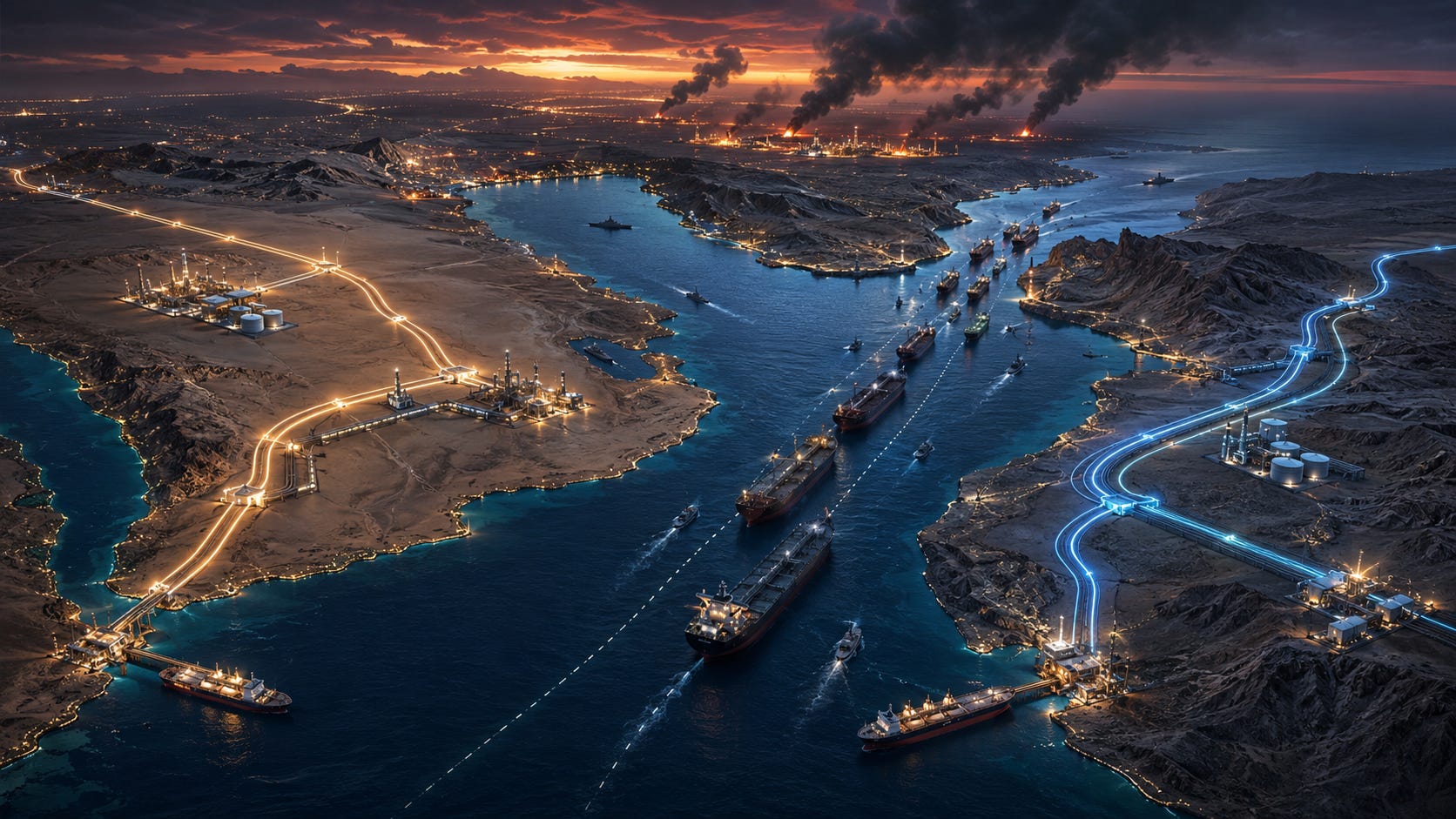
Iran’s leverage over the Strait of Hormuz depends on the world having no easy alternative. By making the chokepoint more dangerous, the war is giving Gulf producers a stronger reason to build one.
For decades, Iran has possessed one extraordinary geopolitical advantage that has little to do with the size of its economy, the sophistication of its conventional military or the reach of its diplomatic alliances.
It sits beside the Strait of Hormuz.
Roughly speaking, Hormuz is valuable because the geography gives Iran leverage over something much larger than Iran itself: the flow of energy out of the Persian Gulf.
Saudi Arabia, the United Arab Emirates, Qatar, Kuwait and Iraq all depend to varying degrees on maritime routes through the narrow waterway.
That dependence has allowed Tehran to wield the threat of disruption as a form of asymmetric power.
It doesn’t need to defeat the United States Navy.
It doesn’t need to conquer Saudi Arabia.
It doesn’t even need to close the Strait completely.
It merely needs to make using it dangerous enough.
And that is exactly what the current war is demonstrating.
Oil markets are already pricing the renewed risk.
At the beginning of September, WTI was above $90 a barrel, Brent around $95 and Murban above $105.
Heating oil has risen sharply.
LNG prices in Asia and Europe have also been pushed higher as disruption around Hormuz restricts Gulf exports.
Tankers have reportedly been struck, shipping traffic has fallen and Qatar has extended force majeure on LNG exports.
VLCC rates have surged to extraordinary levels, while Asian refiners are looking as far afield as Argentina for replacement crude.
On the surface, this looks like confirmation of Iran’s strategic power.
It may ultimately prove the opposite.
Every day Hormuz becomes more dangerous, the economic value of avoiding Hormuz increases.
And countries across the region are beginning to act accordingly.
Gulf producers are accelerating investment in alternative export infrastructure, while some crude is already being rerouted outside Hormuz.
Saudi Arabia and the UAE are expanding existing bypass capacity, while longer-term routes through Turkey, Jordan and Syria are also being explored.
This is important because the strategic power of Hormuz comes not simply from the volume of energy that passes through it, but from the lack of alternatives capable of carrying anything close to the same volume.
So the strategic equation changes.
A pipeline that looked unnecessarily expensive when Hormuz was functioning normally can suddenly look cheap when crude is nearing $100 a barrel.
The calculation changes further when tankers cost hundreds of thousands of dollars a day and a single missile can disrupt billions of dollars in trade.
War changes the economics of redundancy.
Infrastructure built to insure against a low-probability disruption starts to make sense once that disruption becomes real and recurring.
The important comparison is no longer between the cost of a new pipeline and the cost of continuing to use an existing shipping route.
Once disruption becomes recurrent, the real comparison is between the cost of building redundancy and the cumulative cost of being exposed every time Hormuz becomes unsafe.
And once alternative infrastructure is built, the geopolitical consequence can outlast the war that justified it, because the new routes remain available long after the immediate crisis has passed.
This is the paradox Iran now faces.
Its ability to threaten Hormuz derives entirely from the world’s dependence on Hormuz.
But using that threat creates an increasingly powerful incentive for everyone else to eliminate the dependence.
Iran can close Hormuz only while the world still needs Hormuz.
The principle is hardly unique to energy.
Economic coercion tends to contain the mechanism of its own destruction.
The more valuable a dependency becomes as a weapon, the more valuable it becomes for the target to remove that dependency.
Europe discovered this after Russia invaded Ukraine.
Moscow’s ability to cut pipeline gas exposed the strategic cost of Europe’s dependence, prompting governments to invest heavily in LNG infrastructure, storage and alternative suppliers.
Those changes substantially reduced Russia’s leverage over the continent.
The United States and China are discovering the same dynamic with semiconductors and critical minerals.
Washington’s restrictions on advanced chips have accelerated China’s efforts to reduce its dependence on American technology.
Beijing’s controls on rare earths have given the United States an equally strong incentive to build alternative sources of supply.
Supply chains that once evolved around efficiency are increasingly being redesigned around resilience.
Hormuz is now entering the same logic.
For most of the modern oil era, geography won.
The Persian Gulf contains enormous reserves of low-cost hydrocarbons, and Hormuz provides the shortest maritime route connecting those resources with global markets.
Building redundant pipelines and terminals simply to prepare for a hypothetical closure often made little commercial sense.
The hypothetical is no longer hypothetical.
A refinery operator in India, an LNG importer in Asia or an energy ministry in Riyadh can now attach an observable price to geopolitical concentration risk.
This is significant because infrastructure decisions are rarely driven by abstract warnings alone.
They are driven by whether the cost of avoiding a disruption can be justified against the measurable cost of suffering one.
And the present crisis is providing the numbers.
Higher insurance costs.
Higher tanker rates.
Interrupted LNG contracts.
Oil-price volatility.
Emergency sourcing from distant suppliers.
Lost production.
And the possibility that one narrow shipping corridor can transmit a regional war into energy prices across the global economy.
The result will not be the literal disappearance of the Strait of Hormuz.
Its geography is too favourable, the infrastructure surrounding it too extensive and the volumes involved too large for that.
Millions of barrels of oil will continue to pass through it.
The more important question is whether Hormuz remains strategically indispensable.
Those are different things.
A railway can remain busy after it ceases to be the only railway.
A port can remain important after alternative ports are built.
A chokepoint loses much of its strategic power when enough traffic can be routed somewhere else.
That appears to be the direction in which the Gulf energy system is moving.
US Treasury Secretary Scott Bessent has gone considerably further, predicting that the Strait will be effectively bypassed within two years as oil shifts to pipelines.
That timetable looks extraordinarily ambitious given the scale of current Hormuz flows.
But the significance of the remark is that senior US officials are now explicitly treating the Strait’s strategic importance as something that can be engineered away.
The timetable matters less than the direction.
Saudi Arabia has powerful incentives to expand westward export capacity towards the Red Sea.
The UAE already possesses infrastructure capable of moving crude towards the Gulf of Oman without traversing Hormuz.
Iraq has incentives to diversify north and west.
Every Gulf producer now has reason to treat route redundancy not as optional insurance but as strategic infrastructure.
And the more of it they build, the less leverage Iran retains.
There is an irony here that extends beyond the current conflict.
Iran has spent decades demonstrating that it can make Hormuz dangerous.
It may finally have demonstrated the point too effectively.
The Strait will not disappear from maps.
Tankers will not stop using it.
The Gulf will remain one of the world’s most important energy-producing regions.
But strategic power is not determined simply by how much trade passes through a place.
It depends on how difficult that place is to avoid.
The Iran war is making avoidance more expensive in the present.
In doing so, it may be making it much cheaper in the future.
And that could prove one of the war’s most consequential outcomes.
Not that Iran closed the Strait of Hormuz.
But that it convinced the world to build a way around it.


