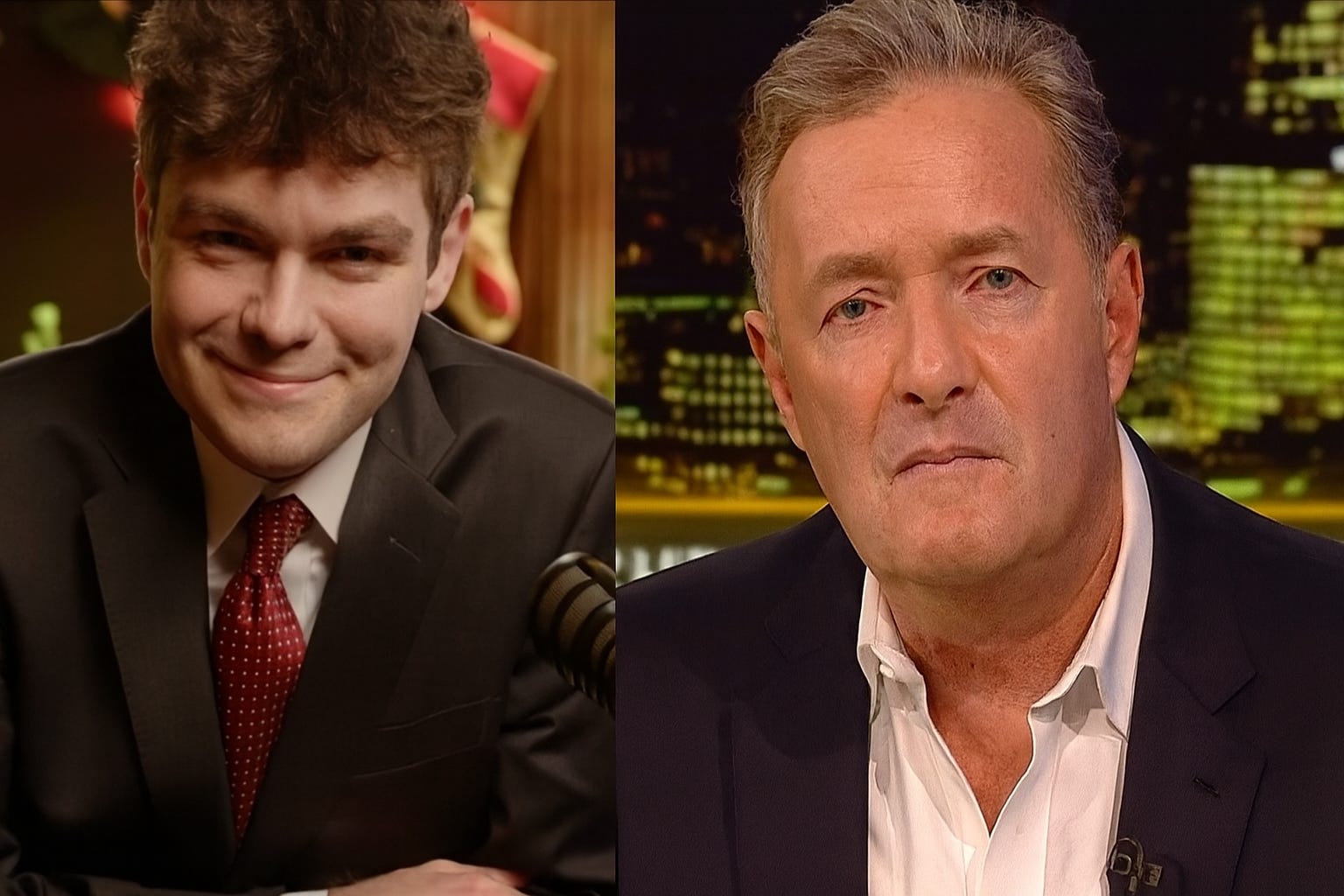
Nick Fuentes Pulls the Plug on Piers Morgan’s Entire Operating System
Piers Morgan froze. Then crashed. Then rebooted into denial.
Nicholas Holt
Editor, The Modern Enquirer
For years, Piers Morgan has presented himself as a spokesman for free speech while policing it more aggressively than many of the people he criticises.
His interview with Nick Fuentes made this contradiction unusually visible.
What he framed as an inquiry into extremism instead revealed the structure of his own method: moral framing in place of argument, psychology in place of inquiry, and emotional leverage in place of logic.
Morgan didn’t approach Fuentes as a guest. He approached him as a diagnosis.
He told the audience they were about to see “what [Fuentes] really is,” signalling that the verdict was set and the interview would simply illustrate it.
Fuentes declined to participate in the staging.
“I don’t like to be tone-policed,” he said.
Morgan replied: “You should be free to express yourself… but I have a problem with the things you say.”
The terms of Morgan’s free speech doctrine appeared immediately: permission granted, followed by conditions imposed. A principle reduced to the dimensions of personal preference.
Morgan then attempted the standard racism trap. Television relies on it because it typically forces the guest into retreat.
Fuentes accepted the accusation and moved on.
The tactic lost its function the moment he refused to supply the shame it requires.
With that avenue closed, Morgan shifted to the personal.
He invoked Fuentes’ father—a private citizen with no relevance to the discussion. The gesture served no journalistic purpose; it operated only as a smear by proximity, a tabloid device Morgan routinely disavows while employing it.
He then moved to insult. Fuentes’ sexual history became a line of inquiry, with Morgan suggesting that not “getting laid” explained his worldview.
The comment was notable for two reasons: Morgan identifies as Catholic, and he made it while arguing for women’s ordination.
Think about it. Piers (a Catholic) shamed a young Catholic on international television for being celibate.
When this failed to destabilise the conversation, Morgan escalated emotionally.
He introduced Daniel Finkelstein, an author promoting a memoir recounting his family’s suffering under Hitler—the arrests, starvation, and death camps.
The history is not contested. The tactic was.
Finkelstein wasn’t introduced to interrogate a claim but to raise the emotional temperature to a level where disagreement could be dismissed as insensitivity.
It mirrored the strategy Morgan used throughout COVID: elevate the stakes high enough that dissent becomes self-disqualifying.
Fuentes identified the manoeuvre instantly.
“Why is this old British guy talking to me?”
The question was labelled callous. In context, it was descriptive. Morgan had outsourced the argument.
When emotional force failed, Morgan tried a different frame: “Is your motivation financial? Is this performative?”
Fuentes answered with a material fact: “I’m banned from banking. I’m banned from credit cards.”
Morgan’s response—“You shouldn’t have been”—was the first visible shift in authority. The accusation collapsed under the weight of detail.
The remaining exchanges followed the same pattern: Morgan returning to psychology; Fuentes returning to principle. The guest answered in sentences; the host answered in diagnoses. The structure of the interview became clearer with each cycle.
The final exchange made it explicit.
Morgan: “Would you agree [that] we’ve got a lot nearer to what the real Nick Fuentes is in the last two hours?”
Fuentes: “Uh, no. I mean, the clip thing — we’ve done the clip thing. We’ve all seen the clip show. Everyone’s seen the clips.”
Then: “You think you’re the first one to do the ADL rap sheet? So here you said this and then here you said that. I’ve been playing that game for ten years.”
And finally: “So this is honestly more of the same, to tell you the truth.”
It was not an insult. It was a structural description.
The man framed as an extremist was the only one speaking plainly.
The man hosting a show titled Uncensored was the only one following a script.
Fuentes had summarised Piers Morgan’s entire modern career: moral confrontations arranged around preselected clips, designed to guide a viewer toward a conclusion decided before the conversation begins.
The interview will not be remembered for revealing anything new about Nick Fuentes. It will be remembered for revealing something about Piers Morgan.
He attempted to diagnose.
He attempted to shame.
He attempted to instruct the audience on what they “now understood.”
He attempted to close the conversation whenever the argument grew uncomfortable.
None of it worked.
What ended on screen wasn’t a debate. It was the demonstration of a method that no longer works on an audience that no longer obeys. The moment Fuentes refused the script, the script had nothing left to offer.
So what is this really about?
It isn’t about Morgan or Fuentes.
Their exchange matters because it exposed a pattern that long predates either of them.
For years, figures like Morgan have positioned themselves above the audiences they address, assuming the role of cultural interpreter.
Their authority rests on a presumption: that they understand the moral terrain better than the public, and that their task is to correct, refine, or discipline public instinct. The interview revealed how fragile that presumption has become.
At the centre is a truth widely sensed but rarely articulated: the routine shaming of the white male has functioned not as principle but as status.
Morgan’s posture toward Fuentes was not unique; it was part of a broader trend that treats one demographic as inherently suspect and perpetually in need of supervision.
The performance is familiar, and so are the incentives.
For decades, institutions rewarded this stance. The fastest route to appearing enlightened was to create distance from the majority one came from.
The pose offered moral elevation at minimal cost. But the interview showed that the audience no longer defers to the pose.
The framework depends on deference; the deference has eroded.
No society maintains coherence while pathologising its own people.
Yet for years the culture treated the white male as the only group it was acceptable to generalise about, criticise collectively, or characterise as inherently problematic.
The interview signalled that this approach no longer carries the authority its advocates assume.
Morgan entered the studio operating from a worldview that sustained much of his career: define the moral field, diagnose the subject, instruct the audience. The interview showed how dated that model now appears. The public hasn’t grown more extreme; it has simply grown less obedient.
That is the shift the interview exposed. Not extremism. Not ideology. A change in cultural hierarchy.
The authority figures who once shaped public perception through moral framing now find the audience examining the frame instead of the subject.
That was the quiet revelation: the method itself is under scrutiny, and the old tools no longer produce the old results.
This interview was not a story of a broadcaster confronting a controversial figure.
It was the story of western elites confronting a culture that no longer accepts their diagnosis.


I still know little about Nick Fuentes. I dislike Piers and have for a long time, probably since he tried to frame the 2nd Amendment as outdated and useless and savage. It doesn't surprise me about the Fuentes de-banking, but this should be illegal or certainly not used as it commonly is- they de-banked Trump!
I only knew that Fuentes is commonly described as racist, and this is now thrown around so commonly that it means nothing any more.